Veeam and Securiti: Data Trust Redefines Security Strategy
Veeam completed the acquisition of Securiti today, a move that reflects how customer expectations are changing as AI becomes embedded across enterprise workflows.
For a long time, enterprises approached data protection and security through an operational lens. Backups focused on recovery. Security tools focused on infrastructure and access. Governance lived in a separate world, often driven by compliance teams. Those boundaries are now breaking down, and data itself is moving to the center of security decision-making.
AI is the catalyst.
AI changed how data behaves, and that changed what security teams need
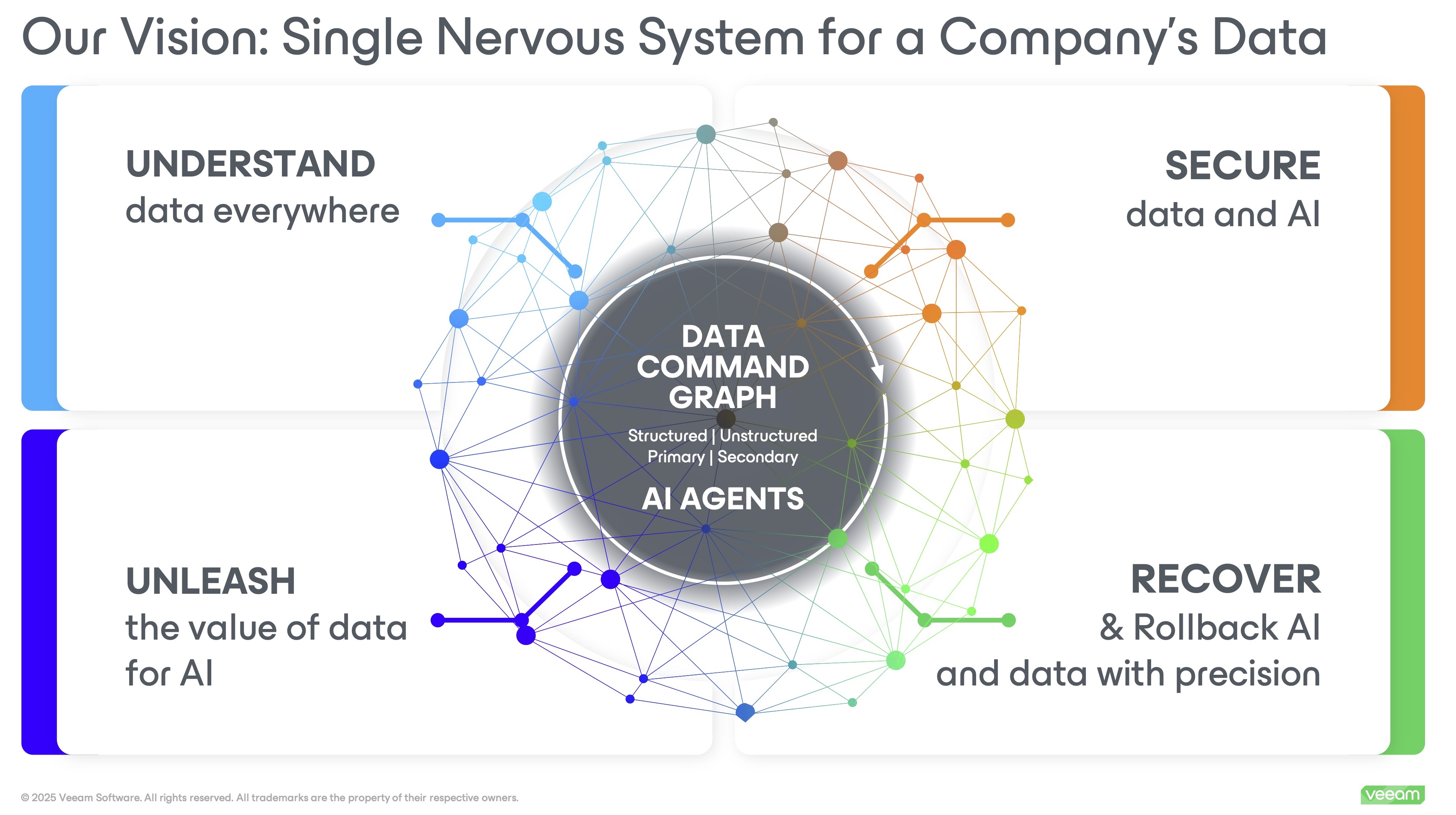
AI has turned previously dormant data into active fuel. Unstructured documents, logs, recordings, and historical files are now being indexed, summarized, embedded, and reused across copilots and agent-driven workflows. Data is no longer static or slow moving. It is accessed, transformed, and recombined at machine speed.
That shift exposes a problem many organizations have lived with for years but could afford to ignore. Most enterprises do not have a consistent, up-to-date understanding of what data they have, where it lives, who can access it, and what risk it carries.
In AI-driven environments, that gap moves beyond governance and becomes a delivery issue. Security, privacy, and risk teams increasingly slow or pause AI initiatives because they cannot establish trust in the data supply chain quickly enough.
[Source: Veeam]
Why data awareness is moving closer to the core platform
This is where capabilities such as data discovery, classification, and risk context start to matter more. Often described as data security posture management (DSPM), these capabilities help organizations continuously understand sensitive data across structured and unstructured environments and apply policy-driven controls.
What is changing is the role these capabilities play. Data awareness is becoming foundational to how security, governance, and AI programs operate, rather than something added later.
Securiti’s role in this shift reflects what buyers are looking for: persistent visibility into data, contextual understanding of sensitivity and risk, and the ability to apply consistent policies as data moves and is reused. As AI usage expands, that visibility becomes essential.
From “can we recover” to “can we recover and trust what we restored”
Another shift I see in buyer conversations is a change in how recovery success is defined.
Restoring systems quickly is no longer sufficient. Teams want confidence that restored data is clean, compliant, and safe to reuse. In AI-driven environments, restored data is often reintroduced into analytics, search, or downstream AI workflows, which amplifies any underlying data issues.
Deeper data understanding increasingly influences operational outcomes. Knowing what data is sensitive, what data was impacted, and what data should be prioritized or restricted now carries as much weight as the mechanics of recovery.
What this means for enterprise buyers
The broader takeaway from this acquisition goes beyond one vendor’s roadmap and points to how enterprise buying criteria are evolving.
Buyers are increasingly looking for platforms that:
- Provide continuous visibility into sensitive data across environments
- Apply consistent policies to data, regardless of where it resides or how it is accessed
- Support AI use cases without introducing unmanaged data risk
- Connect data understanding to real operational actions, including recovery and reuse
This does not imply that every organization needs a single, monolithic platform. It does suggest that fragmented approaches, where data insight, security controls, and operational processes remain siloed, are becoming harder to sustain.
Where this leaves security leaders
Veeam’s acquisition of Securiti reflects a broader market reality. AI has shifted the center of gravity in security from systems to data. As data becomes more fluid, more valuable, and more exposed, enterprises need stronger, more integrated ways to understand and control it.
Data discovery and classification may not be the most visible parts of an AI strategy, but they are quickly becoming some of the most consequential. Security, governance, and recovery all now converge on a single prerequisite.
Do you actually trust your data?
Chirag Mehta is Vice President and Principal Analyst focusing on cybersecurity, next-gen application development, and product-led growth. With over 25 years of experience, he has built, shipped, marketed, and sold successful enterprise SaaS products and solutions across startups, mid-size, and large companies. As a product leader overseeing engineering, product management, and design, he has consistently driven revenue growth and product innovation. He also held key leadership roles in product marketing, corporate strategy, ecosystem partnerships, and business development, leveraging his expertise to make a significant impact on various aspects of product success. His holistic research approach on cybersecurity is grounded in the reality that as sophisticated AI-led attacks become…...
Read morePublished
Author