


AWS launches forward deployed engineering unit with $1 billion investment
Amazon Web Services launched a forward deployed engineering group with a $1 billion investment to focus on the last mile problem with AI deployments. AWS Forward Deployed Engineering will be priced on fixed pricing based outcomes not billable hours.
The investment in building out the AWS FDE unit will cover scaling its engineering teams, market development funds, cash and credit investments and partner allocations to accelerate customer outcomes.
Brian Mitchell, Director, Product and Solutions at AWS, said the company has deployed FDEs at projects at the Allen Institute, Cox Automotive and the National Football League. "As we work with customers across industries, it's clear that the conversation has shifted," said Mitchell. "Customers aren't asking what AI can do anymore, they're asking, 'how do I make it part of my business that actually runs.' This is a fundamentally different problem, and it breaks at the last mile."
In a nutshell, AWS' FDE unit will focus on the messy intersection where models meet workflows. Mitchell said:
"Multi-agent is the new baseline, and enterprises are reimagining entire business processes, not just automating a single task. This means orchestrating networks of agents that plan, decide, and execute across workflows. The complexity isn't the model, it's the integration, the governance, and the operational effort to make it production grade. What we're seeing is that most customers hit a wall."
Key points:
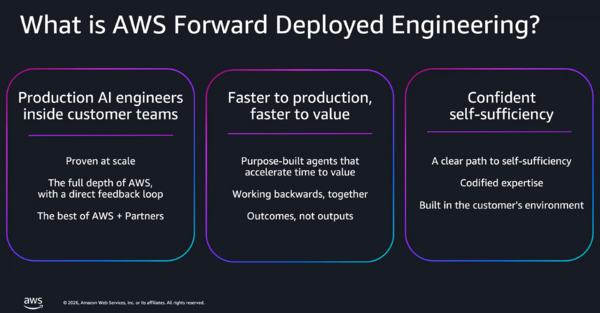
- AWS FDEs will embed AWS engineers directly into customer teams.
- FDEs from AWS are an extension of core engineering not a separate consulting unit.
- AWS will be hiring FDEs to scale.
- The approach is to start from a customer problem and work backwards to the solution.
- AWS' FDE unit will be led by Francesca Vasquez, VP of Frontier AI Engineering and Services.
- AWS Context and semantic layers will play a big role in FDE engagements. AWS is pushing ontology as a way to keep AI agents consistent. "This FDE solution is this enterprise-wide semantic context, and bring ontology where it makes sense for customers. One of the things that we are intending to do here is to implement this semantic context in probably almost all of our engagements," said Mitchell.
- The expectation is that AWS FDEs are likely to stay engaged with customers to take on additional use cases.
AWS' FDE effort will start with hundreds of engineers following AWS' AI 45 methodology, which revolves around 45 minutes to an idea, 45 hours to a prototype and 45 days a customer engagement. That time will be longer or shorter based on the use case.
Mitchell said AWS is looking to design a framework for customers, bring methodologies, tools and skills and implement outcomes. The customer will have an exit strategy so they can carry out projects on their own.
What's unclear is whether AWS' FDE program meets the definition of a Palantir-ish FDE where you had someone that understood the technology as well as the business. Mitchell said AWS FDE program will have domain knowledge and the company is working through details. For instance, regulated industries such as financial services, healthcare and public sector will be target areas for AWS FDEs.
Mitchell emphasized that the AWS FDE program isn't competitive with partners and complementary. Partners will bring domain expertise and industry knowledge. "From a partner play we have they will play an important role here, we think that they'll be able to contribute model expertise, industry knowledge, and complementary skills that ensure the right engineers are available to the right customers at every stage, so we'll be investing in enabling our partners to go with us," said Mitchell.
The groundswell of FDEs
AWS move lands after Google Cloud recently outlined its partner strategy that includes a hefty dose of FDEs.
Google Cloud's Partner Network is value and outcome-based with tiers tied to deployments. Google Cloud is investing $750 million into the Gemini Enterprise Transformation Program, which includes embedding FDEs from Google.
Meanwhile, OpenAI recently launched the OpenAI Deployment Company, which includes FDEs to combine OpenAI frontier models with enterprise systems. Anthropic has a similar unit. Many SaaS vendors now have FDEs too.
Toss in an army of FDEs from traditional systems integrators and consultants and there's a groundswell of FDE help available. Here's the catch: Some of these FDEs don't necessarily fit the definition and are glorified sales and customer success people.
Constellation Research CEO R "Ray" Wang said the never-ending stream of newly minted FDEs require buyer scrutiny.
"I'm tired of looking at fake FDEs. A real FDE understands how to take the requirement and put it back into the product and actually get something done. These aren't glorified sales consultants or sales engineers. They actually are building product at the same time as they're actually going out to solve the problems at an organization, and they're not field CTOs, and they're not architects. The true FDEs are the folks that are like the consultants from the 90s, and I'm talking like folks that were literally had like 160 to 180 IQ. They knew what they were doing. Today there's so many fake FDEs."
Larry Dignan is Editor in Chief of Constellation Insights at Constellation Research, where he leads editorial coverage focused on enterprise technology, digital transformation, and emerging trends shaping the future of business. He oversees research-driven news, analysis, interviews, and event coverage designed to help technology buyers and vendors navigate complex markets with clarity and context. ...
Read morePublished
Author
