


How Moody's is thinking about data moats, AI strategy, token costs
Moody's is juggling agentic AI workflows, protecting its proprietary data from LLMs and engaging in healthy co-opetition with AI partners that can be friend or foe. In between, Moody's is also managing token costs.
Welcome to a snapshot of Moody's business and AI trade-offs most enterprises are making. Speaking at an JP Morgan investor conference, Cristina Pieretti, general manager and head of generative AI solution at Moody's, laid out the company's strategy.
Moody's AI strategy has multiple moving parts. In some ways, AI is a threat to its proprietary data business and various services. On the other hand, AI and various vendors in the ecosystem are frenemies. These partners could be long-term threats, but also necessary distribution strategy. In addition, Moody's is developing its data sets and decision workflows.
The value prop for Moody's services is helping you make decisions that won't cost you a lot of money. Think about credit and compliance risks. Moody's data also sits in multiple layers of the AI stack.
"You don't want to make a bad credit risk decision because you're going to lose a lot of money. You don't want to underwrite an insurance policy and not look at the risk. Again, there are big financial consequences," said Pieretti. "It's about developing workflow solutions in those high stake areas that are leveraging all the connected intelligence."
Moody's data includes 600 million entities, 2 billion ownership links, research and ratings as well as domain expertise on credit risk, know your customer and compliance. Moody's Orbis database provides beneficial ownership mapping and entity resolutions across 170 data sources.
The company's AI and data strategy revolve around three pillars.
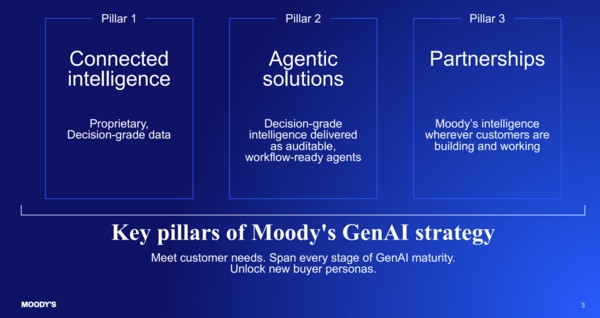
Key items in Moody's strategy include:
- Anthropic, AWS, Microsoft, OpenAI, Databricks and Salesforce are seen as partners that amplify the reach of Moody's and reach new buyer personas.
- Moody's is protecting its IP whether it owns the customer relationship or not and aims to power intelligence for high-stakes workflows.
- Moody's is also licensing data to enable customers develop their own models.
- And Moody's is looking to meet customers wherever they work.
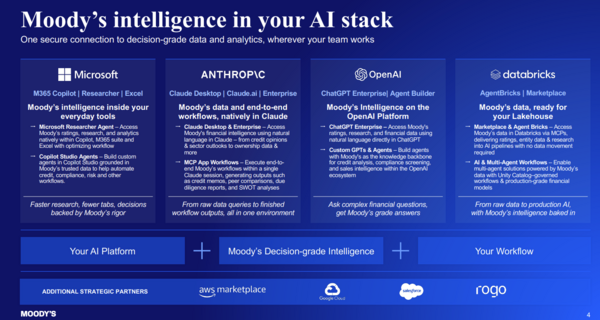
Here's a look at Moody's strategy and the nuances.
Partners: Pieretti said Anthropic is Moody's "most architecturally distinctive partnership." The company has connected its data via model context protocol (MCP) for availability within Anthropic's Claude.
In addition, Moody's launched an MCP app, which is an interactive agent interface that provides access to Moody's agents, generate outputs and trade sources without leaving Claude. This approach isn't a data feed or API, but an effort to render Moody's Intelligence without a workflow.
With AWS, Moody's is available on AWS Marketplace and embedded into Amazon Q. Other partnerships have similar characteristics.
Token economics: Pieretti said token economics depend on how a customer accesses Moody's Intelligence. The first path is a customer consuming Moody's through its interface and environment. In that category, Moody's "carries the underlying token costs and builds them into our pricing," she said.
Pieretti said:
"If you think about the risk of the token, it's on us to understand what is the cost per token. Of course, we do negotiate the volume with the customers. But at the end, that token cost is on Moody's and it's included in the price. So, the customer gets kind of a clean, predictable relationship. They pay for Moody's Intelligence and outputs without managing the variable token consumption separately."
The second path is connecting to Moody's via MCP. In that scenario, the customer is on the hook for token costs from whatever environment used.
Managing token costs: Pieretti said Moody's has to closely watch its token costs. The costs are just one part of the token equation. She said:
"We are monitoring every single thing that the customer consumes, and we're also monitoring our token costs. And it's not only about the token cost, but what is the model? We have the ability to select the model we're using for everything that we're providing to the customer. We are very careful to use the model that makes more sense, not only from an economic standpoint but also from a performance standpoint, from a reasoning standpoint, and from a follow direction standpoint."
Pieretti said that approach gives Moody's the freedom to assign tasks to models that aren't as pricey. Managing token costs is about managing multiple levers and picking the right model for the job.
Use cases: Moody's is focusing its AI efforts on the use cases that generate the most value for the company and customers. "We want to make sure we have the right data, the right context and it's AI ready for agent workflows," said Pieretti. "We are very deliberate about prioritizing those places where the stakes are the highest."
Those high-priority use cases are credit risk, know your customer and insurance underwriting workflows.
The data moat: Pieretti said Moody's data moat is driven by the data as well as the relationships between them. Much of Moody's data isn't publicly available. "We have over the years created and have developed a lot of commercial agreements, licensing arrangements, royalty relationships with over 170 sources that, again, have been -- are either exclusive or semi-exclusive," she said. "No LLM can generate a Moody's rating."
Moody's also must maintain the data and connecting intelligence via construction, curation, linking, resolving and standardizing. The data changes constantly.
Moody’s has to protect its proprietary data.
"When a customer runs a workload inside Claude or another partner environment, they're querying Moody's data through the MCP. They're not receiving a copy of the underlying data set. The data remains within Moody's governed infrastructure and then the outputs are generated on demand, they're sourced, they're attributed and the underlying data is not really exposed. We monitor the volume of calls that is done through an MCP or through a smart API, et cetera. I would say between the contractual agreements, the fact that you are not receiving a full copy of our database and then the fact that we're monitoring all of this, there's a robust framework there to prevent the training by LLMs."
Larry Dignan is Editor in Chief of Constellation Insights at Constellation Research, where he leads editorial coverage focused on enterprise technology, digital transformation, and emerging trends shaping the future of business. He oversees research-driven news, analysis, interviews, and event coverage designed to help technology buyers and vendors navigate complex markets with clarity and context. ...
Read morePublished
Author
