


Accenture places $4.2 billion bet on OT cybersecurity amid mixed outlook
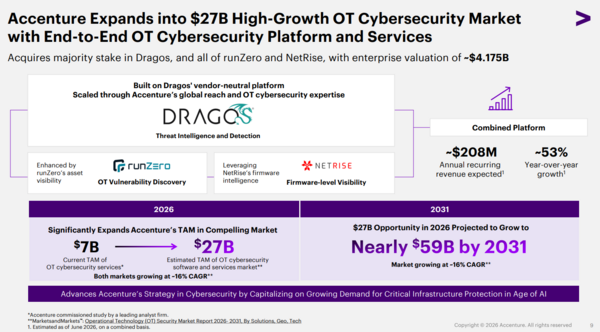
Accenture is beefing up its cybersecurity business with a focus on operational technology. The company said it will acquire a majority stake in Dragos and all of runZero and NetRise in deals valued at $4.175 billion.
The consulting firm already has a $10 billion cybersecurity business and is doubling down on operational technology (OT) and securing power grids, pipelines, factories and similar infrastructure.
Accenture said the combination of the three companies have about $208 million in annual recurring revenue through June with growth of 53%. Accenture said the deals will be initially dilutive to earnings, but drive growth and earnings in the future.
Dragos, which provides OT threat detection, proprietary data and a neutral platform, will be combined with runZero, which has exposure assessment and attack-surface intelligence, and NetRise, which has firmware-level visibility into device exposure. Accenture will unify the platforms and operate the OT cybersecurity unit as an independent entity led by Dragos CEO Robert M. Lee.
Accenture CEO Julie Sweet said the company is "confident Dragos’ differentiated OT platform will accelerate our growth in the critical infrastructure and industrial operations markets."
Sweet said Accenture is looking to be "the reinvention partner of choice for our clients and the leader in widespread adoption of AI."
And you can't have AI without real security. Sweet said:
"These acquisitions will create a first-of-its-kind OT Security platform that lets clients see threats, find vulnerabilities and fix them before it becomes a crisis.
Cyber is a key enabler for AI. We cannot have an AI revolution without critical infrastructure, and you cannot have those without OT Security, which is where today the world is most vulnerable. The urgency is real. AI and geopolitical risks are accelerating the need for cybersecurity adoption for the operational technology that underpins critical infrastructure and industrial operations, such as power grids, pipelines, manufacturing, distribution facilities and data centers."
Separately, Accenture reported a solid third quarter, but a fourth quarter outlook that fell short of expectations largely due to US federal spending.
The company reported earnings of $3.80 a share on revenue of $18.7 billion, up 6% from a year ago. Accenture's constant currency growth was 3%.
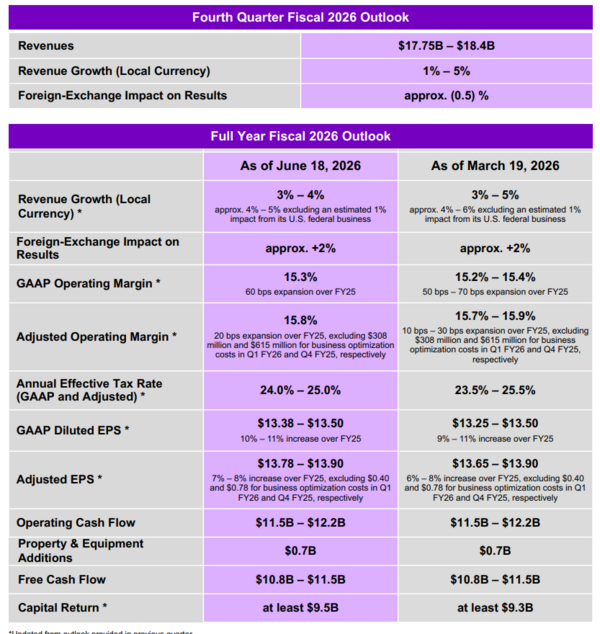
As for the outlook, Accenture projected fourth quarter constant currency growth of 1% to 5% and fiscal 2026 revenue growth of 3% to 4%. The previous range was calling for 2026 growth of 3% to 5%. Earnings guidance was in line with the previous outlook.
Sweet outlined the moving parts in the quarter. She said:
"We were impacted by the conflict in the Middle East. We saw a revenue impact of approximately $100 million compared to our expectations, which is all consulting type of work, split evenly between the direct impact on our Middle East business and indirect effects outside of the region. In the last few weeks of the quarter, we saw this indirect impact globally in products and to a lesser degree, in resources, mostly in discretionary spend. In addition, sales in the Middle East were impacted by approximately $400 million and also in EMEA due to longer decision-making."
In addition, "a couple of our large managed services opportunities moved into FY '27 for company-specific reasons."
Other notable points from Accenture:
The company is going after mid-market companies. Sweet said:
"We estimate that the mid-market, which we look at as companies with between $300 million and $3 billion of revenue, is a $240 billion addressable market for us, growing high single digits. That is why we are launching a new business next week called Accenture Edge.
This business will embed Accenture's large enterprise expertise and ecosystem relationships in business solutions designed specifically for the mid-market. We see that companies in this segment face many of the same technology, data, AI, cybersecurity and productivity challenges at large enterprises. But they often need solutions that are faster to deploy, more repeatable and rightsized for their scale."
AI projects include data projects. "A lot of our reinvention work today is helping clients get ready for AI and data remains a critical enabler with at least 1 out of every 2 advanced AI projects continuing to lead to a data project," said Sweet.
Token and AI spending optimization now critical. Sweet said:
"We have a whole practice that we're starting to grow now and it's on how to help clients optimize their use of tokens. It feels a lot like the cloud scenario. We remember when people were moving to the cloud, and then they were like, oh, wait a minute, we're not -- we're spending a lot more on the cloud than we thought, and we built a whole FinOps practice on helping optimize cloud.
So we definitely think that we're seeing that with the clients, and they're coming to us because we're doing a really good job ourselves of being able to know how you use the tokens, which models you use for which problems and that's something we've been focused on since the very beginning. It's also helping because we have delivered real ROI and our clients are seeing the spend, but they're struggling with the ROI and so it's helping us there."
Larry Dignan is Editor in Chief of Constellation Insights at Constellation Research, where he leads editorial coverage focused on enterprise technology, digital transformation, and emerging trends shaping the future of business. He oversees research-driven news, analysis, interviews, and event coverage designed to help technology buyers and vendors navigate complex markets with clarity and context. ...
Read morePublished
Author
